
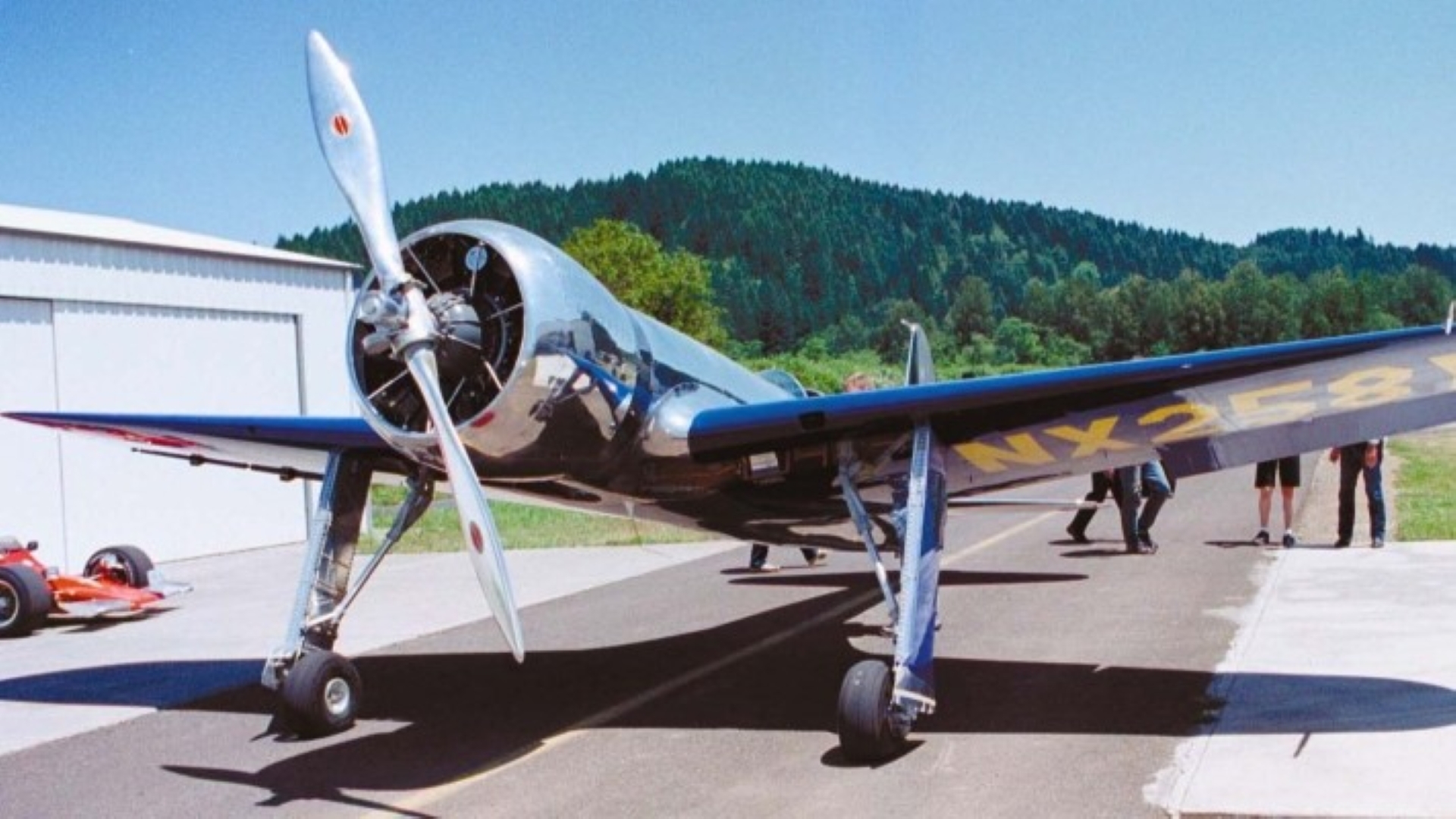
80" Hughes H-1B Racer
Howard Hughes' Silver Bullet — the last private aircraft to hold the world speed record — in giant scale. One of the most beautiful aircraft ever built.
A Legend, Faithfully Cut
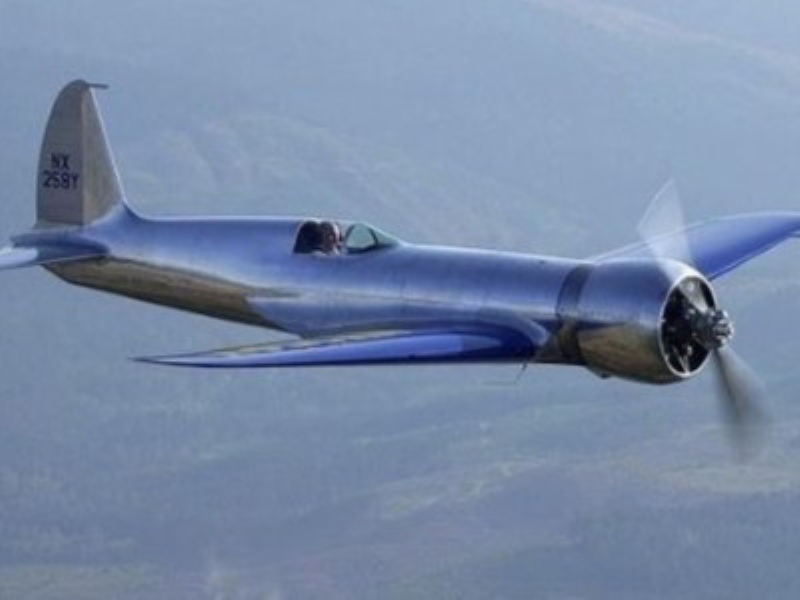
The Hughes H-1 Racer was designed by Richard Palmer and built by Howard Hughes in 1935 — described at the time as "one of the cleanest and most elegant aircraft designs ever built." On September 13, 1935, Hughes flew the H-1A (short wing) to a world landplane speed record of 352 mph. On January 19, 1937, fitted with the longer H-1B wing, Hughes crossed the U.S. from Los Angeles to Newark in 7 hours 28 minutes — a new transcontinental record. It was the last aircraft built by a private individual to hold the world air speed record. The original is now in the Smithsonian National Air and Space Museum.
The H-1's legacy extended far beyond its records. Its retractable landing gear, flush rivets, and wing fillets directly influenced the design of the Mitsubishi Zero, Grumman Wildcats, and early WWII fighters. Dick Katz's giant-scale design captures that unmistakable aerodynamic precision at 80". Kit Cutters supplies the laser-cut wood — this guide covers everything else you'll need to complete it.
What's in the Box?
Included in the Short Kit
- Precision laser-cut wood parts only — ribs, formers, shaped parts
- H-1B long wing rib set (80" span)
- Fuselage formers and shaped parts
- Laser-cut balsa parts for the built-up cowl
Required Separately
- Plans / building instructions (buy from Ziroli — copyright)
- Spars, sheeting, and stick balsa
- Engine or motor, covering, finishing (Alclad for scale aluminum look)
- Covering, finishing (Alclad for scale aluminum look)
- Electronics, servos, hardware
Everything Else You Need to Complete This Kit
The H-1 has a shorter accessory list than most warbirds — no bomb bay, no dive brakes — but the finish is the most demanding in the catalog. Achieving the H-1's mirror-polished aluminum look takes planning before you cover a single panel.
Power System
The 80" H-1B suits 35–50cc gas or a comparable electric outrunner. The real H-1 used a Pratt & Whitney R-1535 radial of about 1,000 hp — your cowl conceals the engine, so both gas and electric suit the streamlined aesthetic equally well.
GAS — common choice| Engine | 35–50cc gas. DA-35, DA-50R, or Zenoah 38 suit the 15–22 lb weight class. | Desert Aircraft |
| Fuel tank | Sized to engine; position for CG | Dubro |
| Prop | Sized per engine and cowl clearance. A scale-look 2-blade wood prop suits the H-1's prewar racer aesthetic. | Builder preference |
| Motor | ~35–50cc class outrunner, 190–230 KV — proven on 15–22 lb giant-scale airframes | Specialty RC retailer |
| Battery | 10S–12S LiPo; position carefully for CG in the long, narrow fuselage | Specialty RC retailer |
| ESC | 100–130A with generous margin | Specialty RC retailer |
Cowl
Built per plan| H-1 fiberglass cowl | Built up from balsa and ply per plan — the H-1's beautifully tapered bell-shaped cowling is constructed using the balsa mandrel method: a laminated plywood cylinder capped with a balsa leading edge ring, sanded and faired to shape. | Per plan (included in kit) |
Canopy
No commercial source — see options| H-1 cockpit canopy | No confirmed commercial source for the Dick Katz 80" H-1 canopy. Options: (1) secondary RC market — search "Hughes H-1 canopy giant scale"; (2) vac-form from card stock per plan; (3) vac-form using a simple fixture per the plan sketch. | Secondary R/C Market |
Landing Gear
Retracts — straight up into wingThe retractable landing gear was one of the H-1's pioneering design features — the main gear folds straight up into the wing. Confirm strut length and retract angle against the plan before purchasing.
| Main retracts | Electric or pneumatic retracts sized for 15–22 lb; main struts retract straight up into the wing roots per the original aircraft. Confirm mounting angle against plan. | Robart / specialty |
| Air kit (if pneumatic) | Robart air kit with tank and quick disconnects | Robart |
| Main wheels | Small diameter scale wheels — the H-1 had notably small wheel fairings | Robart / Dubro |
| Tail wheel | Small fixed tail wheel per plan | Robart / Dubro |
Servos
5+ channels| Ailerons | 2× 65+ oz-in, ball bearing | Builder preference |
| Elevator | 1× 65+ oz-in, ball bearing | Builder preference |
| Rudder | 1× 90+ oz-in, ball bearing | Builder preference |
| Split flaps (optional) | 2× 65+ oz-in if split flaps fitted — shown on plan as per the real aircraft | Builder preference |
| Throttle | 1× 50 oz-in | Builder preference |
| Gear | 1× 50 oz-in | Builder preference |
Covering & Finishing
The H-1's finish is the defining challenge of this build. Howard Hughes personally insisted on machined flush rivets and a mirror-polished skin. Getting that right on the RC model is what separates an average build from an exceptional one.
| Airframe finish | 1 oz fiberglass cloth + epoxy resin, sanded to gloss before painting. Primer coat essential before Alclad. | Chief Aircraft / specialty |
| Metallic paint | Alclad II metallic lacquers — the builder standard for realistic bare metal. Apply over black gloss primer for maximum reflectivity. Key shades: Polished Aluminum (ALC-107) lower surfaces, then paint blue upper surfaces. | Hobby Linc |
| Blue topcoat | The H-1B used royal blue upper surfaces. The H-1A speed record version was scarlet and white — different scheme, confirm which version you are modelling. | Builder preference |
Hardware
| Control horns & linkages | Sized per plan; concealed linkages where possible to maintain the H-1's clean exterior | Specialty RC retailer |
| Hinges | Flat hinges or Robart hinge points | Robart / specialty |
Detailed Specifications
| Wingspan | 80 in (H-1B long wing) |
| Scale | 2⅝" = 1 ft |
| Weight (AUW) | 15–22 lb (estimated — varies with power system) |
| Power | 35–50cc gas or electric equivalent |
| Airfoil | NACA 23012 (per original aircraft) |
| Wing | H-1B long wing with split flaps (short H-1A wing also on plan) |
| Gear | Retractable — main gear folds straight up into wing roots |
| Cowl | Built per plan — balsa/ply mandrel method |
| Canopy | No confirmed commercial source — secondary RC market / vac-form |
| Min. radio channels | 5 (ailerons, elevator, rudder, throttle, gear) + optional flaps |
Specs from Dick Katz's published H-1B Racer plan specification, distributed by Nick Ziroli Plans. The plan includes both the H-1A (short, speed record) and H-1B (long, transcontinental record) wing templates — the Kit Cutters short kit is the H-1B long wing version.
Dick Katz
Dick Katz designs are distributed through Nick Ziroli Plans and include the Hughes H-1B Racer, Stinson 105, Stinson 108-3 Station Wagon, and other classic American aircraft. His plans are known for historically accurate outlines and full-size templates for all structural parts.
Get Dick Katz PlansThe Build Journey
The H-1's structure is not unusually complex — it's the finish that sets this build apart. Plan the finishing sequence before you cut the first rib. Treat these ranges as a rough sense of scope.
Where a short kit saves you time
Dick Katz's plan includes full-size templates for all ribs and formers. A Kit Cutters short kit removes the cutting stage entirely — your parts arrive laser-cut and labeled, so you start at assembly with more time to dedicate to the finish work that defines this model.
The four stages of assembly
Stage 1: Fuselage Assembly
The H-1's streamlined, rounded fuselage — designed around the minimum possible frontal area.
- Align and pin main fuselage formers
- Install engine mount and fuel bay
- Build cockpit area and canopy frame
- Fair fuselage to engine cowl fit
Stage 2: Wing Assembly
H-1B long wing with retract bays and optional split flaps.
- Build wing panels with NACA 23012 ribs
- Install retract bays — confirm fold angle against plan
- Fit optional split flaps
- Sheet and finish wing surfaces
Stage 3: Tail Assembly
Clean, conventional tail group — minimal frontal area per the original.
- Build the horizontal stabilizer
- Build elevator surfaces
- Assemble fin and rudder
- Install tail wheel per plan
Stage 4: Finishing & Final Assembly
The stage that defines this build — the Alclad bare metal finish.
- Fiberglass cloth and epoxy over entire airframe
- Sand to gloss, prime with black gloss
- Apply Alclad metallic lacquers
- Install engine, retracts, radio, canopy
Frequently Asked Questions
Ready to Build Your Hughes H-1B Racer?
Buy the 80" H-1B Racer Kit — $552.00
Premium laser-cut short kits for large-scale and giant-scale radio-controlled aircraft builders. USA-based quality craftsmanship for serious hobbyists.
Shop
Resources
Newsletter
Subscribe for new kit announcements and build tips.
© 2026 Kit Cutters. All rights reserved.