

134" Grand Esprit
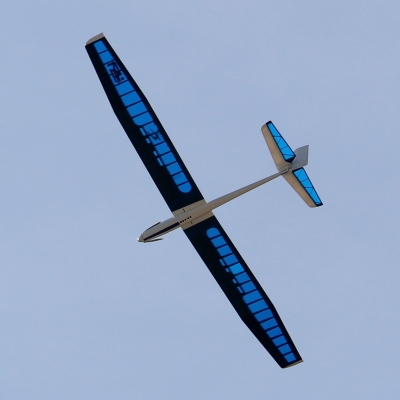
Lee Renaud's legendary giant sailplane — the competition standard of the 1970s and 1980s, available in Original and Improved Sinclair 3014 Wing versions.
A Legend, Faithfully Cut
Lee Renaud designed the Airtronics Grand Esprit and introduced it on the cover of RCM magazine in July 1973. It was the first multi-task competition sailplane to be commercially kitted — introducing spoilers and a V-tail to the RC soaring scene at a time when those features were considered advanced. Through the late 1970s and 1980s, the Grand Esprit dominated the NSS (National Soaring Society) competition circuit. One example placed first at both the WRAM and Toledo shows and is now in the AMA's National Model Aviation Museum.
Kit Cutters offers this in two versions: the Original Standard Wing from the 1974 Airtronics plan, and the Improved Sinclair 3014 Wing with corrected rib templates by Alan Sinclair. The fuselage, tail boom, and all other components are identical between versions. This guide covers both.

What's in the Box?
Included in the Short Kit
- Precision laser-cut wood parts only — ribs, formers, shaped parts
- Wing rib set (Original or Sinclair 3014 — per version ordered)
- Fuselage pod formers and shaped parts
- V-tail surface structure parts
Required Separately
- Plans (free from Outerzone.co.uk — oz9015)
- Fiberglass tapered tail boom (not included — no commercial source)
- Wing spars, sheeting, spruce, and stick balsa
- V-tail mixer (mechanical or radio mixing)
- Towhook, pushrods, horns, hardware, covering
- No engine, no motor, no landing gear — pure sailplane
Everything Else You Need to Complete This Kit
The Grand Esprit is a pure sailplane — no engine, no cowl, no landing gear. The accessory list is shorter than any warbird in this catalog, with one significant exception: the fiberglass tapered tail boom, which has no current commercial source.
Tail Boom
No commercial source — see optionsThe Grand Esprit uses a fiberglass tapered tail boom — not included in the short kit. The original Airtronics kit supplied a yellow-tone fiberglass tapered boom. No commercial replacement is currently available. Three options are documented in the builder community:
| Option 1 — Secondary market | Original Airtronics tail boom occasionally appears on eBay and RC Groups classifieds. Search "Airtronics Grand Esprit tail boom" or "Airtronics Grand Esprit parts." | Secondary R/C Market |
| Option 2 — Fishing pole blank | Tapered fishing pole blanks (fiberglass or graphite composite) are used by RC soaring builders as tail boom substitutes. Dimensions per plan — taper must match the plan specification. | Fishing / outdoors retailers |
| Fiberglass cloth | Woven fiberglass cloth for tail boom layup — use over a tapered mandrel per plan dimensions | Aircraft Spruce |
| Fiberglass adhesive (epoxy) | Epoxy resin for fiberglass tail boom fabrication — laminating grade, mixed per manufacturer ratio | Aircraft Spruce |
Flight Controls — V-Tail Mixer
RequiredThe Grand Esprit uses a V-tail (butterfly tail) with elevons. A mixer is required to convert separate elevator and aileron inputs to the two V-tail surfaces. The original kit used a mechanical Vector Director II mixer — modern builders use radio mixing instead.
| Radio mixing (recommended) | Any modern transmitter with V-tail or elevon mixing. Program V-tail mix and adjust throws to plan spec. No mechanical mixer needed. | Builder's existing transmitter |
| Mechanical mixer (original) | Vector Director II — occasionally found on secondary market. Obsolete — radio mixing is simpler and more precise for modern setups. | Secondary RC market |
Launch System
Hi-Start, winch, or slope| Hi-Start (bungee) | Surgical tubing Hi-Start — the launch method Lee Renaud invented. 50–100 ft of surgical tubing with a 200–300 ft towline. Standard for field flying. | Chief Aircraft / specialty |
| Electric winch | Club electric winch — the preferred launch for competition. Requires a field with winch infrastructure. | Club facility |
| Slope soaring | Suitable for slope sites with sufficient lift — hand launch from the slope. | No purchase needed |
| Adjustable towhook | Heavy-duty adjustable towhook — required for Hi-Start and winch launch. Position per plan CG notes. | Chief Aircraft / specialty |
Servos
2–3 channels| V-tail surfaces (×2) | 2× 50–65 oz-in ball bearing — one per V-tail surface (elevon mixing in radio) | Builder preference |
| Spoilers (optional) | 1× 50 oz-in if spoilers fitted — shown on plan as optional | Builder preference |
Hardware & Pushrods
| Pushrods | Standard nylon or steel RC pushrods — the original kit included a full hardware set. Buy a selection of DuBro or Sullivan pushrods sized per the plan. | Dubro / Sullivan |
| Control horns & clevises | Nylon or metal control horns and ball-link/clevis set — sized per plan | Dubro |
| Hinge material | Full-span hinges for V-tail surfaces per plan — plan specifies full-span hinge type | Dubro / specialty |
| Wing spars | Double hardwood spars with plywood webbing on the inboard panel — per plan specification | Specialty balsa supplier |
| Belly skid | Belly skid per plan — no landing gear on this model | Per plan |
Covering & Finishing
| Covering | Iron-on film (Monokote, Oracover, or Ultracote). The classic Grand Esprit color scheme is white fuselage pod with high-visibility wing tips — red, white, and blue is the most documented competition scheme. | Chief Aircraft / specialty |
| Canopy | Vacuum-formed canopy (butyrate) — included in the original Airtronics kit; source from secondary market or vac-form per plan. Occasionally available as repop. | Secondary RC market |
| Instrument housing | Vacuum-formed instrument housing — included in original kit; source from secondary market or substitute with a simple hatch cover. | Secondary RC market / per plan |
Detailed Specifications
| Wingspan | 134 in |
| Wing area | 1,100 sq in |
| Flying weight | 60–70 oz (3.75–4.4 lb) |
| Airfoil | Eppler |
| Wing construction | Double hardwood spars, plywood webbing (inboard), geodetic ribs, elevons |
| Tail | V-tail (butterfly) — elevon mixing required |
| Boom | Fiberglass tapered tail boom — not included, no commercial source |
| Fuselage | Pod-and-boom — plywood pod sides, 1/2" balsa floor, 1/4" plywood keel insert |
| Gear | Belly skid only — no landing gear |
| Launch | Hi-Start, electric winch, or slope |
| Spoilers | Optional — shown on plan; significantly shortens landing |
| Min. radio channels | 2 (V-tail mix) + optional spoiler channel |
| Wing versions | Original Standard Wing / Improved Sinclair 3014 Wing |
Specs from the original Airtronics Grand Esprit specification and RCM 1975 review. The Sinclair 3014 wing uses revised rib templates with corrected geometry — fuselage and all other specs are identical. Plans free from Outerzone.co.uk, plan ID oz9015.
Lee Renaud & Airtronics
Lee Renaud founded Airtronics, Inc. in 1971 and the Grand Esprit was his landmark design. He invented the surgical tubing Hi-Start — the standard field launch method still in use today — and the Grand Esprit was the first multi-task competition sailplane to be commercially kitted. His later designs, the Aquila, Aquila Grande, and Aquila XL, built on the Grand Esprit's legacy. The AMA inducted Renaud into its honor rolls for his contributions to model aviation.
The Build Journey
The Grand Esprit is described in the original RCM review as building "easier than anticipated" with "nothing unusual" about the radio installation. The geodetic wing construction is distinctive — both time-consuming and satisfying — and the pod-and-boom structure is clean and well-documented. Treat these ranges as a rough sense of scope.
Where a short kit saves you time
The Grand Esprit's geodetic wing ribs are its most distinctive and time-consuming structural element — intricate cross-members that must all be individually cut and fitted. A Kit Cutters short kit delivers those ribs laser-cut and labeled, removing the most tedious stage of the build.
The four stages of assembly
Stage 1: Fuselage Pod Assembly
The plywood pod sides with balsa floor and plywood keel insert.
- Build the plywood pod sides
- Fit keel insert and floor
- Install towhook and nose ballast bay
- Fit the tail boom to the pod rear
Stage 2: Wing Assembly
Geodetic ribs over double hardwood spars — the heart of the Grand Esprit build.
- Build the main spar box
- Fit geodetic ribs (laser-cut from short kit)
- Install elevon hinges and control linkages
- Sheet and cap the inboard panel
Stage 3: V-Tail Assembly
The V-tail surfaces — the feature that made the Grand Esprit distinctive in its era.
- Build the two V-tail panels
- Install full-span hinges
- Connect elevon control rods through the tail boom
- Verify V-tail angle per plan
Stage 4: Systems & Final Assembly
Radio, covering, and pre-flight.
- Install servos and radio gear in pod
- Program V-tail mix in transmitter
- Cover with iron-on film
- Balance to plan CG and adjust towhook position
Frequently Asked Questions
Ready to Build Your Grand Esprit?
Buy the 134" Grand Esprit Kit — $132.00
Premium laser-cut short kits for large-scale and giant-scale radio-controlled aircraft builders. USA-based quality craftsmanship for serious hobbyists.
Shop
Resources
Newsletter
Subscribe for new kit announcements and build tips.
© 2026 Kit Cutters. All rights reserved.