Short Kits vs Scratch Cutting: An Honest Comparison
Short Kits vs Scratch Cutting:
An Honest Comparison
Kit Cutters—August 15, 2026—From Plans to Flight Line, Post 3
This is the third post in the From Plans to Flight Line series. The first two posts covered choosing a subject and researching it. This one picks up at the next practical decision: once you have your plans, how do you get the wood parts you will build from?
A note on transparency: Kit Cutters produces laser-cut short kits, so we have an obvious interest in this question. We are going to give you the honest version anyway, because experienced builders can tell the difference, and because the right choice genuinely depends on the builder and the build. Read this as a practical comparison, not a sales pitch.
Every builder who works from plans eventually faces the same question: do you trace and cut every part yourself from raw sheet stock, or do you source a short kit with the shaped parts already cut?
Both paths produce finished models. Both have been used successfully by serious scale builders for decades. The question is not which method is right in the abstract — it is which method makes sense for you, for this specific aircraft, at this point in your building life.
Here is what each method actually involves, where each one has a genuine advantage, and how experienced builders tend to make the call.
What Scratch Cutting Actually Involves
Most plans designed for scratch building include full-size templates for every wood part. The builder traces each template onto appropriate sheet stock, cuts it out — typically with a hobby knife or scroll saw — sands it to shape, and then begins assembly.
For a large-scale warbird with a typical rib count, this means tracing and cutting twenty, thirty, or more individual ribs, each requiring careful attention to the template line. Add fuselage formers, bulkheads, wing tips, and structural doublers, and the parts-cutting stage alone can represent a significant number of hours before the first piece of balsa is glued to another.
Builders who scratch cut generally have one of three reasons: they want complete control over wood selection and thickness at every point in the structure, they find the cutting stage a genuine and satisfying part of the building process, or cost is a meaningful consideration. All three are legitimate. None of them are reasons to apologize.
The limitation of scratch cutting is not the skill involved — any experienced builder can trace and cut a rib. The limitation is consistency and cumulative error. When twenty ribs are cut by hand from twenty separate template tracings, they will vary. Sometimes that variation is negligible. Sometimes, particularly on a wing that needs a consistent airfoil across its span, it shows up in the finished model.
What a Short Kit Actually Includes
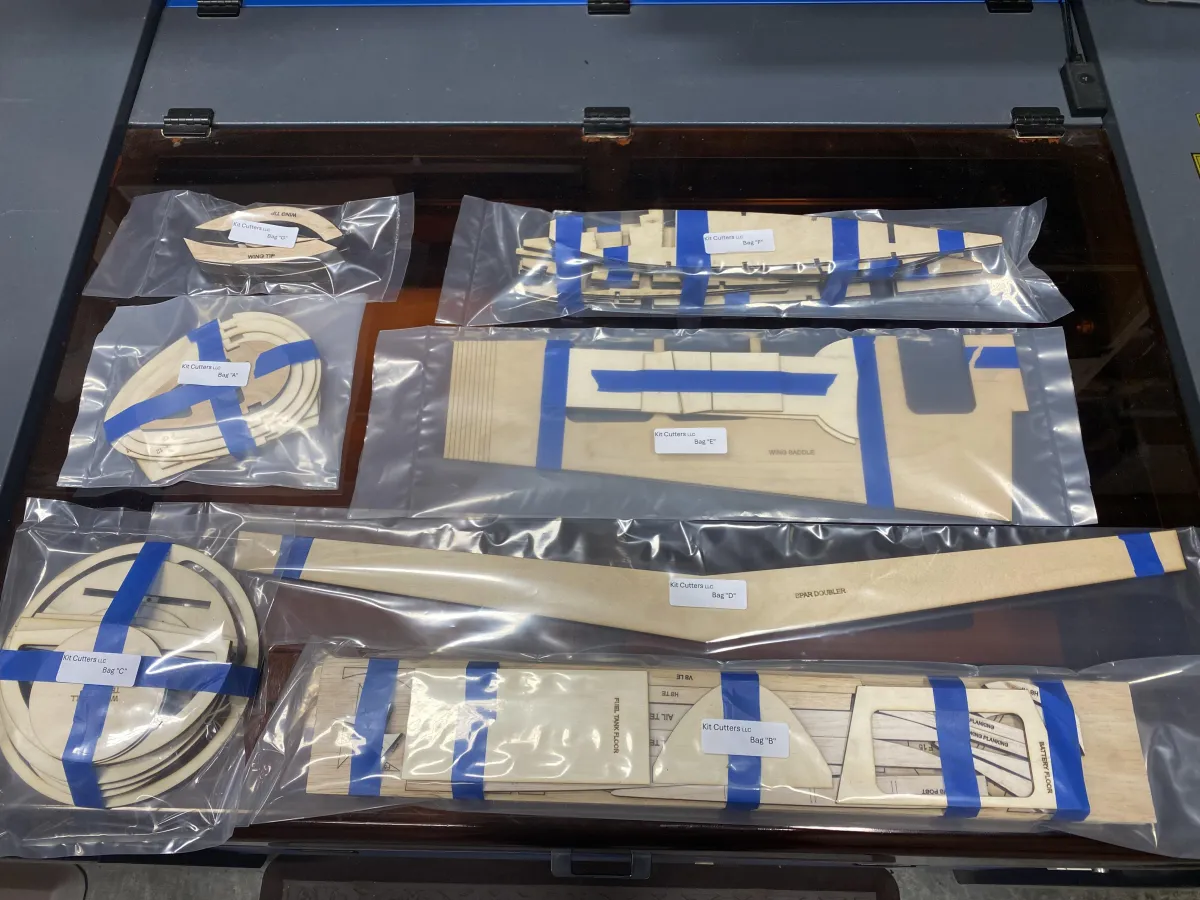
A short kit supplies the precision laser-cut shaped parts — ribs, formers, wing tips, and complex structural pieces — while leaving the builder to source standard sheet and stick wood separately. It is not a full kit. The plans, spars, sheeting, stringers, and all hardware are still the builder's responsibility.
The distinction matters because short kits are sometimes described as a way of avoiding the building work. They are not. A short kit removes one stage of the process — the parts-cutting stage — and leaves everything else exactly as it was. The assembly decisions, the structural choices, the fit and finish, the systems installation, the covering and painting: all of that is still yours, the same as it would be on a scratch-cut build.
What laser cutting does differently from hand cutting is two things. First, every rib is identical to every other rib — not approximately the same, actually the same. Second, the notches and tabs that parts interlock through are cut with kerf compensation, meaning the laser accounts for the width of the beam itself so that mating parts fit cleanly rather than requiring sanding to close the gap. For complex joints on large-scale aircraft, that precision matters.
A short kit does not build the model for you. It removes the repetitive cutting stage so the time you have goes into the work that actually shows.
Where Scratch Cutting Has the Advantage
Scratch cutting gives the builder complete control at every point. If a rib wants to be slightly thicker at the spar location for a particular reason, you cut it that way. If you prefer a specific grade of balsa for the wingtip sheeting that is not what a kit supplier would choose, you source it yourself. The structure is entirely yours, in both the building and the material selection.
For builders who genuinely enjoy the parts-cutting stage, scratch cutting also keeps more of the building experience in the builder's hands. There is a satisfaction in tracing a template, cutting carefully to the line, and seeing a pile of identical-ish ribs accumulate at the end of a session. If that part of the process is meaningful to you, a short kit removes it.
Cost is also a real factor. A short kit is an additional purchase on top of the plans. For a builder on a tight budget, or one who already has a well-stocked wood supply, scratch cutting keeps the parts cost close to zero beyond the raw material.
For simpler aircraft with low rib counts, straightforward formers, and no complex shaped parts, the scratch-cutting advantage is most pronounced. The parts are not difficult to cut accurately, the consistency issue is manageable, and the time investment is reasonable. A basic trainer or a simple biplane is a natural scratch-cut candidate.
Where Laser Cutting Has the Advantage
The laser-cutting advantage grows significantly with the complexity of the aircraft. An elliptical wing — the Spitfire being the most demanding example in this catalog — requires consistent rib geometry across a planform that changes shape continuously from root to tip. Cutting twenty non-identical ribs by hand and building a wing that holds a true airfoil is possible, but it requires exceptional care and skill. Laser-cut ribs that are identical by definition make the job considerably more forgiving.
The same principle applies to fuselage formers on aircraft with compound curves, to wing tips that need precise shaping, and to any part where small variations compound over the length of a structure. The larger the aircraft, the longer the structure, and the more those small errors add up.
Time is the other honest advantage. The parts-cutting stage on a large-scale warbird is not a weekend's work. For a builder with limited bench time — evenings and occasional weekends rather than a full shop day every week — the hours saved on cutting are hours that can go into the detail work that actually determines how the finished model looks. The cockpit. The panel lines. The scale detail that makes a model worth looking at up close. That trade is worth making for most serious large-scale builds.
There is also the error cost to consider. A rib cut wrong from raw stock is discarded and recut. On a complex part that required significant layout time, that is a real setback. A laser-cut part arrives correct. If it gets damaged during assembly, a replacement can be cut.
At a Glance
Scratch Cutting from Plans
Laser-Cut Short Kit
Complete control over wood selection
Parts arrive ready to build
No additional kit purchase
Every rib is identical — no cumulative variation
The cutting stage is part of the experience
Kerf-compensated tabs and notches fit without sanding
Works well for simpler aircraft with low rib counts
Strongest advantage on complex aircraft with many shaped parts
Cumulative error possible across many hand-cut parts
Time saved goes into assembly, detail, and finishing
Most satisfying for builders who value the full process
Right choice when bench time is limited and accuracy matters
How Experienced Builders Actually Decide
Most experienced scale builders do not have a fixed position on this. They make the call per project and consider two questions.
The first is the aircraft's complexity. For a design with straightforward geometry and a moderate part count, scratch cutting is very manageable. For a complex warbird with a demanding wing planform, compound fuselage curves, or a large number of shaped formers, the argument for laser-cut parts is much stronger.
The second is the build window. A builder with long, uninterrupted stretches of shop time can absorb the cutting stage without losing momentum. A builder who works in shorter sessions — or who is returning to the hobby after a gap and wants to get back to the assembly work without a long parts-cutting warm-up — will get more out of a short kit.
The builders who tend to be most satisfied with their choice are the ones who made it deliberately rather than by default. Scratch cutting because you want to scratch cut is a good reason. Scratch cutting because you did not know a short kit was available is a different situation. The same goes the other direction — a short kit chosen because it is the right tool for a complex build is a good decision. A short kit chosen because it seems easier is a less satisfying starting point for a build that will take months.
The Takeaway
Neither method is superior. Both have produced exceptional models. The right choice depends on the aircraft, the builder, and the time available.
For a serious, large-scale warbird with a complex structure and limited bench time, a laser-cut short kit is usually the more practical starting point. The consistency and time savings are real, and the building is no less yours for it.
For a builder who values the complete process, has the time and skill to cut accurately, and is working on an aircraft where that level of control matters, scratch cutting remains a legitimate and satisfying choice.
The bench is the same either way. The aircraft is still yours to build.
If you are working through this decision for a specific aircraft, the Kit Cutters Buyers Guide at KitCutters.com includes a short kit vs hand-cut comparison for each aircraft in the catalog — including exactly what parts the short kit provides and what you will still need to source separately.
Next in the series: Setting Up for the New Build Season — September 15, 2026. Flying season is winding down for most northern builders. The next post covers what experienced builders do before the bench gets busy to make sure the building season starts well.