
Setting Up for the New Build Season: What Experienced Builders Do in September
Setting Up for the New Build Season:
What Experienced Builders Do in September
Kit Cutters—September 15, 2026—From Plans to Flight Line, Post 4
This is the fourth post in the From Plans to Flight Line series. The first three covered choosing a subject, researching it, and deciding how to source your wood parts. This one steps back from those specifics and addresses the seasonal transition that shapes how well the actual building goes.
For most builders in the northern United States, the flying season ends somewhere between late October and mid-November. The thermals drop off, the weather closes in, and the field starts to feel like a different place. That is when the bench comes back.
The building season that follows will be six months long for many of these builders — November through April, with flying resuming when conditions allow in May or June. That is a significant stretch of time, and how it starts tends to determine how it finishes.
Builders who start the season well-prepared — project confirmed, plans understood, materials on hand, shop organized — tend to build consistently and maintain momentum through the harder stretches of a long project. Builders who start underprepared spend the early weeks of the season doing the work they should have done in September, and by the time they are ready to actually build, some of the energy has gone.
September is not building season for most northern builders. But it is the month that determines how building season goes.
For builders in the southern states with a longer flying season and shorter building window, the timing is different but the principle holds. Deliberate preparation before the build starts pays dividends regardless of when that preparation happens.
The builders who start November with the best momentum are almost always the ones who spent September getting ready.
Confirm the Project
If the first three posts in this series have done their job, the project decision is already made. You have chosen the aircraft, done the research, and decided how you are sourcing the wood parts. September is the moment to confirm that decision with some finality before the money starts getting spent.
The question to ask is simple: is this still the right project for this building season? The answer is usually yes. But occasionally a builder reaches September and realizes that the aircraft they chose in June has been superseded by something that grabbed their attention over the summer, or that their circumstances have changed enough that the scope they chose no longer fits the time and space available.
It is far better to make that adjustment in September than to discover it in January with half a fuselage on the bench. A building project that has lost the builder’s genuine interest is one of the hardest things to finish. Confirm the commitment now, while there is still time to adjust.
Get Serious with the Plans
Most experienced builders look at their plans at least twice: once when they are deciding whether to build the aircraft, and again — much more carefully — before they cut the first piece of wood. September is when that second reading should happen.
This is not casual browsing. It is working through the plans in detail, front to back, with a pencil in hand. The goal is to understand the complete construction sequence before starting it, to identify the sections that will require the most attention, and to find any areas where the plans need interpretation or where builder notes from research suggest a deviation is warranted.
Specific things to look for during a thorough pre-build plan review:
☐Construction sequence — what gets built before what, and why
☐Assembly landmarks — where do major sub-assemblies come together?
☐Areas of ambiguity — where the plans leave something to judgment or where experienced builders have noted issues in build threads
☐Jig requirements — which assemblies need to be built over a plan or on a specific jig?
☐Parts that require special stock — non-standard balsa grades, specific ply thicknesses, or hardware that needs to be on hand before assembly begins
The next post in this series covers plan reading in depth. For now, the point is to do it before the season starts, not during it.
Source Everything Before You Need It
This is the preparation step that matters most and gets skipped most often.
There is a particular frustration that experienced builders know well: reaching a stage of the build where the next step is ready to happen, only to discover that the part or material needed is out of stock, discontinued, or six weeks from shipping. It kills momentum in a way that almost nothing else does.
September is the right time to source everything, because at that point there is no urgency and no pressure. If something is backordered, there is time to find an alternative or wait. If a supplier no longer carries a specific part, there is time to research a replacement. If the cowl and canopy need to come from the designer and the designer has a lead time, ordering in September means they arrive before the build needs them.
A complete sourcing list for a large-scale short kit build typically includes:
☐Short kit — order early, confirm lead time and shipping
☐Plans — if not already purchased, order directly from the designer
☐Sheet and stick wood — balsa sheet stock in the specified grades and thicknesses, spars, sheeting, stringers
☐Cowl and canopy — model-specific parts from the designer; often have longer lead times than expected
☐Landing gear and retracts — confirm fit with the specific plan variant before ordering
☐Power system — engine or motor, fuel tank or battery system, ESC if electric
☐Spinner and propeller
☐Servos — confirm torque ratings against the plan specifications for each control surface
☐Wing tube and hardware
☐Hinges, control horns, and fasteners
☐Covering and finishing materials
☐Paint and scale accessories
The Kit Cutters Buyers Guide pages include a verified, aircraft-specific version of this list for every guide in the catalog — with sourced vendor links. For Ziroli aircraft in particular, many of these items ship directly from the designer. Working through the relevant guide page in September is a more reliable approach than reconstructing the list from memory or from incomplete plan notes.
Get the Shop Ready
This sounds obvious, but it is easy to underestimate how much a disorganized or under-stocked shop costs in the early weeks of a build. Not in parts or money — in time and friction.
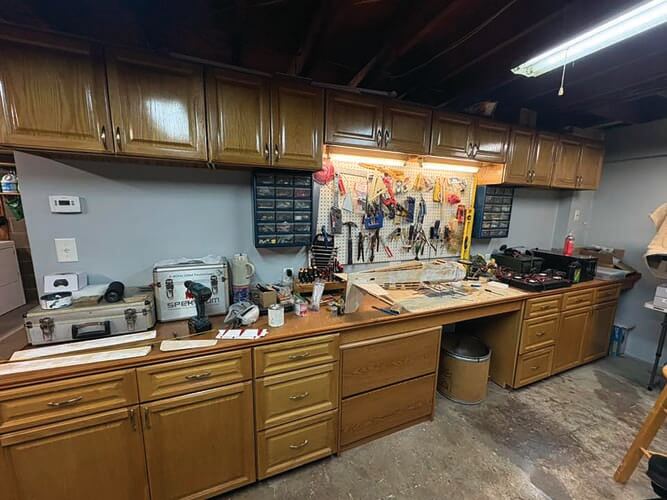
A shop that is ready for building season has a clear bench, organized storage for the incoming materials, confirmed adhesive stock (CA in multiple viscosities, aliphatic resin, epoxy in multiple pot times), a flat building surface that is actually flat, adequate lighting, and tools that are in known locations and in working condition.
September is also the right time to check consumables. Sandpaper in the grits you actually use. Masking tape that is not dried out. Mixing sticks and disposable brushes. The items that seem minor until you run out of them at 10pm on a Tuesday night with a glue joint that needs closing.
Build a Simple Season Plan
Not a project management chart — just a rough sense of how the build breaks into stages and how those stages map to the months available. For a northern builder with a November through April window, six months sounds like plenty of time for a large-scale warbird. It is — but only if the build moves at a reasonable pace and does not stall for weeks waiting on a part or a decision.
Most large-scale builds break down into four natural stages: fuselage assembly, wing assembly, tail assembly, systems, and final assembly. Each of those stages has its own tempo and its own set of materials needs. Knowing roughly when you expect to move from one to the next gives you a practical framework for when to have specific materials on hand and when it is reasonable to expect to be ready for a particular phase.
The plan does not need to be detailed. A single page with the four stages, rough month targets for each, and a sourcing note for what each stage needs is enough. The value is in having thought it through before the season starts, not in having a document to follow.
Make September Count
The building season proper has not started yet. That is the advantage. There is no urgency, no half-finished assembly waiting on the bench, no glue joint that needs to close before the end of the evening. There is time to think clearly, source carefully, and prepare without pressure.
That window is shorter than it seems. October tends to arrive quickly, and with it the end of the flying season and the beginning of the building one.
Use September well. Confirm the project. Work through the plans. Get the sourcing done. Clear the bench. Think through the season ahead. The building itself will go better for it, from the first rib to the last coat of paint.
If you are sourcing a short kit or working through the accessory list for your next build, the Kit Cutters Buyers Guide at KitCutters.com covers verified specs and complete sourcing lists for aircraft in the catalog. A new guide is added every week. Visit KitCutters.com to see what is currently available and to check the guide for your aircraft.
Next in the series: Reading the Plans: What Experienced Builders Look for First — October 15, 2026. By October, the build season is close. The next post covers how to approach a new set of plans before cutting a single piece of wood — what to verify, what to map out, and where most builders find the surprises.